Wednesday, April 25, 2012

Tsao- Spirited Away

Going down the list of movies on the syllabus that we'd eventually watch in this class at the beginning of the semester, the one movie that I recognized and was excited for was Miyazaki's very own, Spirited Away. This movie was my first Miyazaki film, and was the movie that lead me to fall in love with almost all of Miyazaki's films.

picture from here
This story is about a young girl named Chihiro, who adventures into the "spirit world" with her parents. They turn into pigs while indulging themselves with food that they did not pay for, and Chihiro ends up signing a contract with Yubaba, the witch who overlooks the bathhouse that Chihiro will be working in. With the help of Haku, a dragon-spirit trapped in the body of a boy, Chihiro is able to successfully infiltrate into the spirit world and work there until she can get her parents back.

Throughout the movie, one can really see the development and growth in Chihiro. She is very timid and scared of everything in the beginning of the movie, and thinks of only herself. It can be seen when she is complaining and whining in the car with her parents, that she wants things to go her way only. However, at the end of the movie, Chihiro is very brave, and loyal to Haku. She has learned the value of her friendship with Haku, and would do anything to save him. She realizes what's important and not important to her.

Another thing worth noting in this film is the issue of identity as seen plenty of times throughout our past anime movies. When Chihiro signs the contract with Yubaba, she agrees to start going by Sen. Haku reminds her that it is important to remember her name, who she is and where she came from. Eventually, Chihiro helps Haku remember where he comes from, and feels fulfilled knowing where he is from.

I wanted Chihiro and Haku together from the very first scene they were together, and to be honest, at the end of the movie, I was very satisfied that Chihiro was successful in helping Haku. Their love for each other is just so heartwarming. Still the best Miyazaki film, in my opinion.

Saturday, April 21, 2012

Tsao- Nausicaa

picture source
Nausicaa is another one of Miyazaki's films that could fall on my list of favorites. It is a beautiful story about a young girl, Nausicaa, who has a natural love for nature and everything its got to offer- even the insects. Nausicaa is the only human in her village that loves the insects from the forests, and begs her father to not kill them and to save them since she was a little girl. She has a secret garden that harbours all of the "poisonous" plants and the pollen that they sprout, and she explains to her sensei that these plants are not poisonous. What makes them poisonous is the soil, which has been polluted by humans, and everyone has come to believe that the wastelands just have plants that are poisonous by nature.

There are many similarities between this movie and Princess Mononoke, except this movie is a lot more passive and has a much happier ending than Princess Mononoke does. San is much more violent than Nausicaa, but Nausicaa would, just like San, do anything to protect her own kind. Another similarity is that both antagonist/villains in both movies, lady Eboshi and Princess Kushana, come for similar intentions and end up threatening the fate of a perfectly healthy group of people. But in the end, someone with courage, and knowledge of what it really means to be able to coexist and live together with nature comes out to save both humanity and nature.

Nausicaa is loved by everybody and is a great heroine to her valley of the wind. The curse from princess mononoke can be seen in Nausicaa when Nausicaa's father was murdered by the soildiers. Her hatred and anger gave her power and blinded her , leading her to kill a room full of men within seconds. This hatred / curse is reoccurring in Miyazaki's movies, maybe to make the point that hatred can only drive us into a ditch. In these cases, "fighting fire with fire" is typically the method used, but definitely the route to disaster.

The happy ending in Nausicaa is so joyful and happy that it is almost impossible for anybody to not smile or jerk a tear as they watch and progress with the storyline. People do awful things, and as humans it leads to a bigger question: is what we are doing okay? Our generation of people have neglected the effects of our actions, and many of these are major contributors to global warming and other natural disasters that are increasing as time goes by. If our generation of kids does not take action to really look at how we are now, we will surely be paying the price in our near future.

Sunday, April 8, 2012

Tsao- Howl's Moving Castle

picture from HERE


Howl's Moving Castle was another one of Miyazaki's that I really enjoyed. I genuinely chuckled out of pure enjoyment at certain points of the movie; The story was great and the movie was wonderfully directed.

This film had a lot of themes that could be easily pointed out. One of them involved the perception of beauty, and how "beauty comes from within". While Sophie was not considered beautiful compared to her sister, who got all the attention from men every day or her mother, who is married once again to someone rich, she was the most beautiful one on the inside. She was alone and to herself from the beginning of the movie because she had low self esteem, and did not feel she belonged much. She simply worked at the hat shop to fulfill the wishes of her father. Things take a sharp turn however, when Howl finds her in the alley with the soldiers. They were connected by fate from that moment that they met each other. Because of Howl, The Witch of the Waste put a curse on Sophie which turned her into an old gray-haired lady. Through this, she felt more comfortable with herself and who she was because her appearance didn't matter anymore. She could act as herself and from this learned that beauty comes from within.

Howl plays a very handsome, mysterious character. Although I didn't really understand the contract between him and Calcifer in the beginning, and why Howl chose to (or had to) make that contract with him, we learn that Howl has been waiting for Sophie this whole time to help him break the curse and get his heart back. He eventually falls in love with Sophie, and stops running away from things that he needed to face because he felt the need to protect Sophie. My favorite character in the movie would have to be Calcifer and Turnip Head, because of Calcifer's wittiness and Turnip Head's sweetness.

The Witch of the Waste has been drained her powers and turned into a harmless old grandma, but Sophie takes her in anyways even though she proposed a previous threat. This shows her kind heart and maybe why she was the chosen one to break the curse in everyone.

Though Howl eventually turns into a monster, that does not stop Sophie from loving him because he is still the same Howl on the inside. This is a repeating motif in the movie: Beauty lies from within. At the end, we see Markl and Heen and the whole family flying away happily on a new castle, and this scene just makes me feel a heartwarming feeling on the inside. This movie's concepts were not hard to grasp, which makes it appropriate for both children and adults, considering the original story was a children's story.

Friday, March 30, 2012

Tsao- Princess Mononoke

Picture here


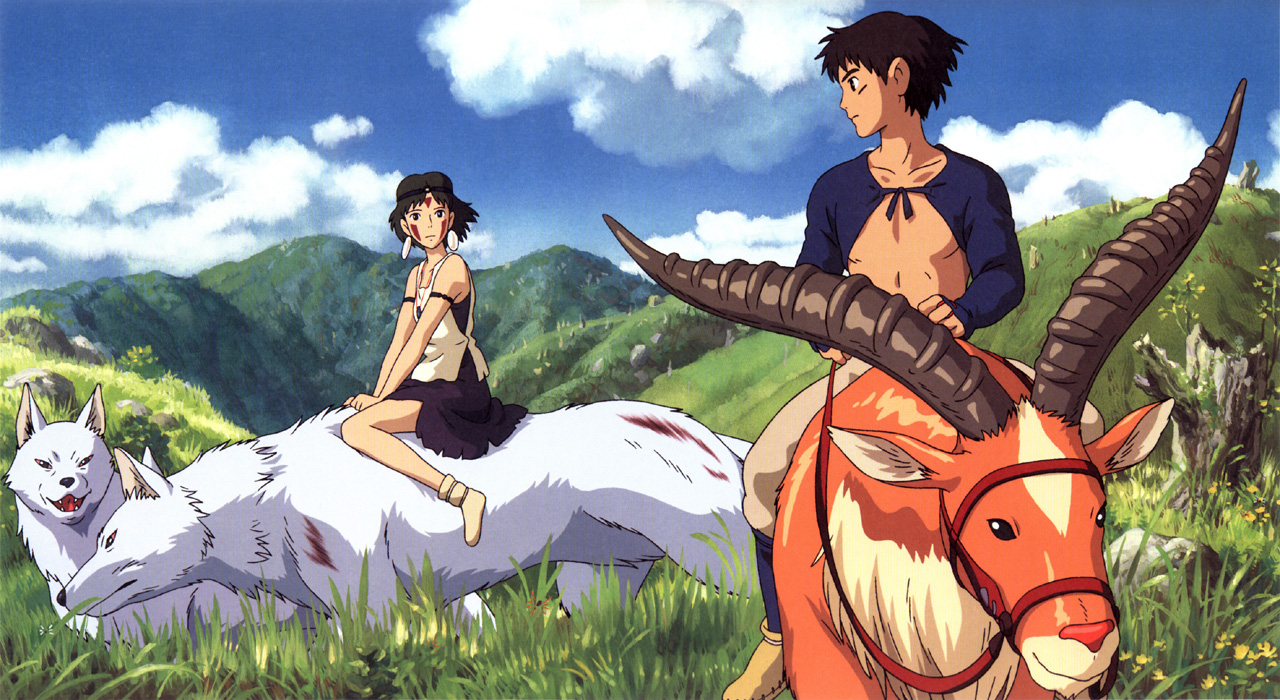
Princess Mononoke is one of the movies that I liked more on the list of anime that we have watched in class. It is such a good portrayal of some problems that we have even in today's world in regard to nature v. technology. This movie reminded me a lot of Dr. Seuss's book and movie, The Lorax. The Lorax was a little creature that lived inside a tree, until the industrialization revolution took place and cut down all of his trees so that they could use it to make other goods with it. However, The Lorax did contain much hatred and vengeance since in that story, the industries and greedy businessmen naturally learned the consequences of taking down the forest at their own cost when their future fell at their own expense.

In Princess Mononoke, however, the message was sent across through the idea of Vengeance and Hatred. Hatred drives a lot of motivation, and at times can give people a power that they did not know they had inside of them. The Wolf clan and San hate Lady Eboshi (and all humans in general), The boars also hate humans, and humans hate between themselves when their interests are conflicted as seen with the citizens of Iron Town and the samurais. This hate will be a neverending cycle if nothing is changed, and even when one side is able to defeat the other side, this hatred will just keep spreading and haunting, like the curse on Ashitaka.

A point that I want to point out is the scene of the Boars all rushing into the war with one goal in mind: to kill the humans and win the war, on behalf of their forest. They were very rash in doing so and the comment of them heading into something without thinking of it, and not stopping until the end was made in the movie when San talks to her mother about going to help the boars (after realizing it was a trap). I feel that a connection can be made with the Japanese army, in the sense that they will fight to their death even if they know they may die, for their one loyal purpose. So this scene may be pointing out that aspect of Japanese culture

Yet another  wonderful work of art from Miyazaki, for all of his movies are very sentimental and portray a very strong message. San was raised in the forest, and loves her home and her family as if she was a wolf herself. This may rise in some identity issues, but one cannot blame her for having a hard time living with and as a human. On a side note, the forest spirit;s ability to take and grant life also shows an importance of balance in our system of nature. A good movie!

Thursday, March 22, 2012

Tsao- Ah! My Goddess


picture from HERE


Ah! My Goddess is a film about the supernatural, divine world and the human’s world intertwining, bringing about new problems for both humans and gods. In the movie, Belldandy, a first class goddess trained by Celastine comes to earth to grant Keiichi a wish, and ends up falling in love with him. Because of their love, Belldandy has stayed on earth for the past two springs, and she plans on staying for another spring. Her sisters Urd and Skuld came down to earth to live with her since she has stayed here for so long.

Belldandy and Keiichi share a bond that is special and cannot be taken away so easily. Celestine takes away Belldandy’s memory of Keiichi with a virus, and this virus has infected both her and the whole Heaven’s computer system. With this virus, Celestin plans to destroy the Judgment Gate as well as the current earth, so that a new one will be created that has no suffering. Celestine’s intentions are not bad ones; he wants equality between Gods and humans, and to remove all suffering from humans- he wants happiness for the humans. However, by destroying earth with his methods he is taking away humans’ free-will and their right to choice. Humans should be able to make choices on their own and decide for themselves whether or not they want to love and be a part of suffering.

Celestine’s definition of happiness may not be the same for everyone. Ah! My Goddess in comparison to the movie we watched in class with prisoner Alex has some similarities, in which Celestine from the anime and the doctors from the movie both want to achieve a “better” state for the victims, but are using the wrong methods to achieve the results. By brainwashing Alex and forcing him to be sick whenever he watches television or hears Beethoven’s music, they are taking away his free-will and decision-making, just like Celestin is taking away the human’s rights for free-will. 

Memory plays a role in this film, as seen in Cowboy Bebop as well, where when one loses their memory, they have trouble determining who they really are and what their purpose is. When Belldandy loses her memory, she loses the part of herself and her happiness that she shared with Keiichi, causing her conflict when she sees Keiichi is no longer as happy as he used to be.

Friday, March 16, 2012

Tsao- Grave of the Fireflies

picture source

In watching the Grave of the Fireflies, I think we can all agree on it being the film that brought everyone to tears. This anime takes place during the end of World War II, a time of alert where American bombers would fly by dropping bombs on neighborhoods and cities, burning large numbers of citizens. Fourteen year old Seita takes his little sister, Setsuko to hide in an old abandoned bomb shelter during an attack. Their mother, hiding in another shelter, was under attack of a bomb while they were hiding and got burned severely. Their mother has heart problems, and dies from the burns soon after Seito sees her. With nowhere else to go, the siblings leave to live with their aunt in another village. Because the aunt is so reluctant and unreasonably mean to them two, they soon decide to move out and live in the abandoned bomb shelter that they found.

Many elements add to the emotional appeal of the film. Setsuko portrays the many innocent souls that were hurt during the war; the audience is quick to fall in love with her naïve, adorable, and relationship with her brother. The touching scenes of Seito providing care to his only surviving family member and most loved sister help to develop the strong relationship that the siblings have. The fireflies, an important symbol in Japanese culture, represent both the souls of living things and mono no aware- that nothing lasts and the sense of beauty in things (since fireflies have such a short life span). The essence of the fireflies is seen in a couple scenes: when Setsuko uses them for light in the cave, burying the dead fireflies and questioning why death must be a part of life (in relation to their mother’s death), the fireflies as symbols of hope, etc. Another aspect worth mentioning in the movie is the tin of fruit drops.

The fruit drops are comforting to both Seito and Setsuko (especially Setsuko), and remind both the kids of a homey, safe, state. With the fruit drops, Setsuko is reassured and willing to keep fighting on with her brother. Eventually, the ashes are also kept in the fruit box tin, showing how important they are to him.
A story with such touching, remarkable emotions in it is a definite watch- one can really get a good sense of how war victims felt during the whole deal. Worth a watch for everyone! 

Wednesday, March 14, 2012

Tsao- Harp of Burma

Picture here


In the Harp of Burma, the story revolves around a young soldier named Yasuhiko Mizushima, who was sent to the mountains after the Japanese army has surrendered to the opposing side to ask for peace from the army in the mountains. Upon leaving his army, he remains missing and does not return to his comrades. We then discover that on his journey home from the mountains, he experiences a conflict within himself when he sees a land full of dead Japanese soldiers left to decay. On one hand he wants to desperately go back to his comrades and return home together, but on another he feels it is his responsible to bury his dead brothers and let them rest in peace.

From Letters of Iwo Jima it can be seen that dying with dignity is a big issue in Japanese culture. The soldiers in the cave killed themselves before the Americans could get to them even if they didn’t want to die, because suicide if it was in honor of their emperor and Japan itself was considered a noble and heroic act. This taboo is not seen much in western films because the idea of a hero in American cultures is portrayed as more of an “invincible” type of character rather than one who takes their own lives.

Throughout the movie, the personal conflict of doing what they feel is their destiny/duty to do, or what they actually want to do (giving a proper burial for the dead soldiers or going home with his comrades) can be clearly seen. As like in the previous anime we have watched, this topic is also touched on in Akira, Cowboy Bebop, and Perfect Blue. Mizushima feels that it is his destiny to help bury his brothers (of Japan) even if it means giving up returning home with his troop. Music is also an issue worth talking about in this movie; the soldiers would sing together when they felt no sense of hope because singing would bring them to a better state. It is important then, to understand that this art is universal and plays a role in lifting spirits. Mizushima’s harp is a part of his identity, and throughout the movie he is recognized by the sound of his harp even when his body is not present in the scene. 

Monday, February 20, 2012

Tsao- Ghost in the Shell


get picture HERE


“Ghost in the Shell” was a film that proposed questions on self-identity, like in Perfect Blue. Unlike it though, it also touched on government corruption and the element of “mecha” in Japanese anime.

The story revolves around Major Motoko Kusanagi and the Puppet Master. Kusanagi is the leader of a government branch called Section 9, and her objective is to find and capture a chain hacker- the Puppet Master. They first track him down to a garbage man, but then they realize that this garbage man has been hacked by the Puppet Master so that he thinks he is looking for his daughter, and that his wife is cheating on him. While conducting further investigation, they find a female robot that has no cells (she is full robot), but for some reason, seems to still have a ghost. Kusanagi then chooses to go inside and talk to the ghost.

The Puppet Master raises a question about what being a human is. He is aware that he is intelligent and is an individual soul, but he wants to be able to reproduce to pass on a part of him to the next generation, and be able to die; he thinks this is what makes him human. Kusanagi decides to join souls with him to make a new life form, for I think she also wants to know how it feels to reproduce and die. However, I do not agree that being able to reproduce and die makes one a human. Being able to reproduce and die indicates sign of life, but not necessarily in human form. What makes humans distinguishable from other animals is our ability to reason and function based on our creativity and ideas. Kusanagi has always wondered who she was and whether she is considered human or not; she would go deep sea diving as a machine just to feel scared, lonely, etc. – feelings that she considers to be humanlike.

The government plays a role throughout the film through the two branches- section 9 and section 6. The Puppet Master was created by Section 6, but because it became so aware and was not able to be controlled by it anymore, they wanted to get rid of it. Section 9 did not know they were investigating something of Section 6 until they come together later on.

Finally, being machine in Japanese Anime helps the females within anime to gain more power. When in their mecha-suits, they have powers that are equal to men; there is little gender roles being played because they are machines. As robots, they have powers that take away the undermining of females, but are still able to maintain a feminine feel through the style of the suits (they are mostly body suits that show off their bodies). Overall, this was a good film with a good ending that is open for interpretations.

Thursday, February 9, 2012

Tsao- Perfect Blue


find picture here


Perfect Blue was a film that many could agree with me- was a crazy, mind f*cking film. The film had touched upon many subjects, such as the male gaze in anime mangas and dramas, what reality really is, and the roles gender play in films.

Mima is the main character in the film, and it is very apparent when she starts to have fragments in her memory and her sense of identity.  As a former pop idol, she had a small yet large enough fan base in which she felt great attention from. Then she became an actress, because her manager and her producer decided that Cham would be better as a duo and without Mima, and that she would be better off as an actress.

Mima then started to star in a film within the film Perfect Blue, called Double Bind. In this film, one of her first big scenes was a rape scene. This rape scene brought back memories similar to those she got from being on stage as Mima the pop idol. Falling that scene, I noticed that Mima started to have some trouble distinguishing between real life and her illusions. Pop idol Mima starts to appear more and more, and taunting actress-Mima every time she appears.

I think an important message that should be mentioned is the impact of the computer and the Internet on people as technology flourished throughout time. When Mima first bought her computer, she had no idea how or what to even do with it not to mention not knowing anything about how websites work at all. An important point is that there are no limitations to how far the Internet can push someone’s sense of reality. Since anyone can have access to the Internet, someone else’s reality may very easily become pushed upon our own. When Mimania, Mima’s fangirl account that speaks as Mima, starts to post blogs and daily updates, Mima starts to get lost and confused between what really happened and what didn’t. The more she is playing this role as a psychotic girl in Double Bind, the more she cannot differentiate between what happens in her reality and what happens in the movie.

The most surprising factor, I believe, to most people is that Rumi is actually crazy as well. We all are lead to believe that Mima is the one who is delusional and has a loss of identity, and while she is, what really pushes the movie to the next level is that Rumi is also delusional and has lost her sense of identity. Rumi takes the identity of pop-idol Mima, and while she, herself, was part of what changed Mima into the new, sell-out actress-Mima, she wants to kill her because she does not like what the new Mima has become. I don’t know. Maybe it wasn’t that big of a surprise for people. But as for me, I still have some questions about what exactly happened throughout the movie, who is truly crazy and who is not, since at the end, Mima portrays herself as someone who knew who she was the whole time. But overall, I enjoyed the level of thinking this film required from the audience.

Friday, February 3, 2012

Tsao- Cowboy Bebop

pictureHERE


Cowboy Bebop was certainly an anime film that is worth noting. From just looks, it does seem like a simple hero-villain movie, but if closely looked at, some important worldly issues can be seen to be brushed upon this film.

For example, the idea of one’s purpose in life; like a post-modernism and existentialism philosophy of life, is brought up when Vincent, our antagonist in the film, questions who and what he really is. He does not remember his past, and does not know what he is doing; he is simply just existing and hoping to find the butterflies again. These butterflies are seen once someone is affected by the bio nano-machines that infiltrate one’s blood cells, used as a terrorist weapon to mass kill everybody on Mars. Vincent was one of the government’s test subjects for this deadly virus, and he was the only one left alive. Because of this, he feels as if he has died already and questions his existence, claiming that earth is a place called “purgatory”- in between heaven and hell. Maybe he thinks that by killing everyone, that he could feel like he is alive again, or that it would bring back the butterfly-euphoria feeling that he had once felt.

At the same time, Spike Spiegal, protagonist and fellow bounty hunter, also questions his own meaning of life as he fights to capture Vincent for him and his team so that they could get the prize of 300 million woolongs. His bounty hunter teammates include Faye, Jet Black, Edward, and their dog Ein. Spike is a carefree, tempered character who used to be a gangster. Throughout the whole film, the idea of loneliness is also brought up. Nobody wants to be alone; Jet Black got upset and really anxious when Faye and Spike went missing for a couple days, thinking that they left him behind and didn’t even “bother to call” when they were really captured and in their own troubles; Vincent wants to leave purgatory because he feels so lonely here, with no past and no assurance of who he is…

My last comment would be that this film portrays a cold, heartless government that is willing to show no mercy to protect their secret. With secret underground laboratories, etc, the government wants to kill off everyone who has knowledge of the virus. Electra, the government’s own people, and Spike are both put in jail and ready to be executed because they simply know too much. Such a cold brutal government is definitely portrayed through Cowboy Bebop.

Monday, January 30, 2012

Tsao- Ninja Scroll


CLICK for picture 

Although it can be portrayed as a movie that has explicit violence and no deep meaning to it, Ninja Scroll was a movie that portrayed a deep intake of a lot of sensitive topics in today's society, such as: objectification of females, a just/unjust world, heroic characteristics, power, and the issue of molestation/rape.


get picture HERE
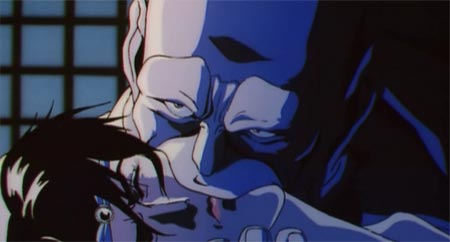
To start out with, Kagero, the female ninja part of the mini clan plays a large role in identifying the issue of molestation/rape and objectification of females. Kagero is molested by both the first antagonist (Tessai), of whom is big, monstrous looking, and has a very ugly temper, and again when she is held hostage by another ninja that is part of the 8 demons of Kimon. During these scenes, she is being tossed around like an inanimate object, and the scenes are filmed in a dark, intense background in comparison to when the Chamberlain was having sex with his woman. While reporting back to the Chamberlain after Tessai wiped out the whole clan on the first mission to the villiage, Kagero was talking to him while he was having sex like it was not a big deal at all. Women are looked at to be only good if they can offer sex, and thus Kagero became a ninja, since she could not love and give up her body. Because she poisons every person she has sexual contact with, she identified herself as an object.

ROBIN HOOD HERE
This story of Jubei in Ninja Scroll is often compared to the one in Robin Hood. Both question the ethical aspects of a just and unjust world, since it is clear that Jubei and Robin Hood have traits of a hero, but the line between what is just and unjust is blurred when both  “heroes” perform actions that are not necessarily approved by the law. Jubei kills and believes that the government is corrupt, and Robin Hood was a thief for the poor and outlawed by his government.

getpicture HERE
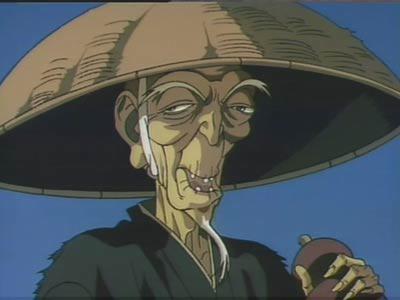
The issue of power is addressed when Dakuan, Gemma, and the Chamberlain are presented, but each in a different way. Dakuan, an undercover Tokagawa shogunate spy, exhibits a controlling power when he poisons Jubei and in a sense forces him to work under him. The Chamberlain, who has very little power, is in reverse, scared to get involved because he does not want to hurt his clan. Knowing that his whole team of ninjas got killed in a mission he ordered, he did not even investigate into how or who attacked them when Kagero reported it to him. And finally, Gemma, who was killed years ago by Jubei himself, has come back to life with immense power and the eight demons that work for him. With all the power he has gained, he feels immoral and corrupted to do whatever he wants with no hesitations.

All in all, if you can ignore the graphic (almost pornography) and violent scenes in the movie, Ninja Scroll is a movie filled with concepts to explore.

Thursday, January 19, 2012

Tsao- Akira


Before watching the film, I assumed from the title of the anime that Akira was going to be a story based on a character affiliated with that name. However, as I watched the film I realized that the character that goes by the name Âkira never once shows up in the story, but has a different significance to the plot. 
GOT THIS PICTURE HERE

AND THIS PICTURE HERE
The setting behind Akira is in neo-Tokyo, where the apocalyptic city is full of chaos, corrupted government and military officials, gangs, motorcycle gangs, and trash all over the place. The women are treated very poorly, and the citizens of this “new” Tokyo are clearly unhappy with the way things are running. This, in my opinion, gives the authority its power more than anything. Because gangs are destroying the city, running through windows of classy restaurants, throwing grenades in police departments, etc., the colonel/general and his authority officials really don’t have much of a choice other than to use force and their power to keep things under control. This, of course, also has to do with the corruption that was initially in place that caused the people to be so unsatisfied as to do damage to show resentment in the first place.

My point is- the general really isn’t the “bad guy” of the film- from where the government stood at the beginning of the film, it is a cycle of “badness” coming from the people of the city, then the government’s reaction, then the people’s reaction, etc.  

PICTURE FROM HERE
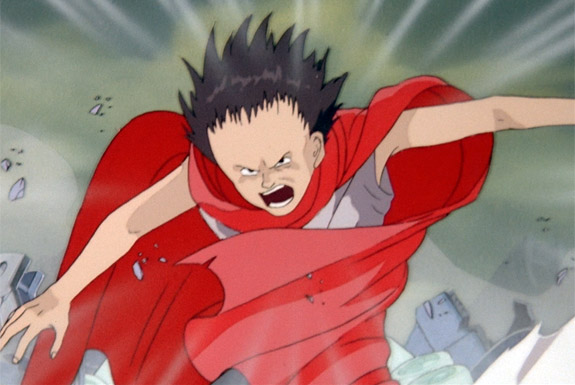
Anyways, Tetsuo becoming corrupted by so much power is a very effective way to portray our own society. When people are given power, they will seldom just give up that power to those without it and just be like “Here’s power! Take it!” Take for example, why slavery lasted for so long. With power, the white people saw no reason to stop oppressing the minority. Thus, after so many years of being oppressed, if an enslaved, black man that has felt inferior his whole life were to discover an unlimited source of power within himself, he could very easily become blinded by such power, and want to cause harm to all those who have undermined him before- therefore becoming an “Akira” (In comparison to Kaneda making Tetsuo feel inferior through his protective nature, causing Tetsuo to feel he is always living in the shadows)

Akira, therefore in a sense, is more than just a character’s name in the plot. Akira is the art of abusing raw power; the learned experience of a mistake easily made and prone to repeat; and the result of an imbalance in equality and respect amongst peers.

RAAAAAAAAA